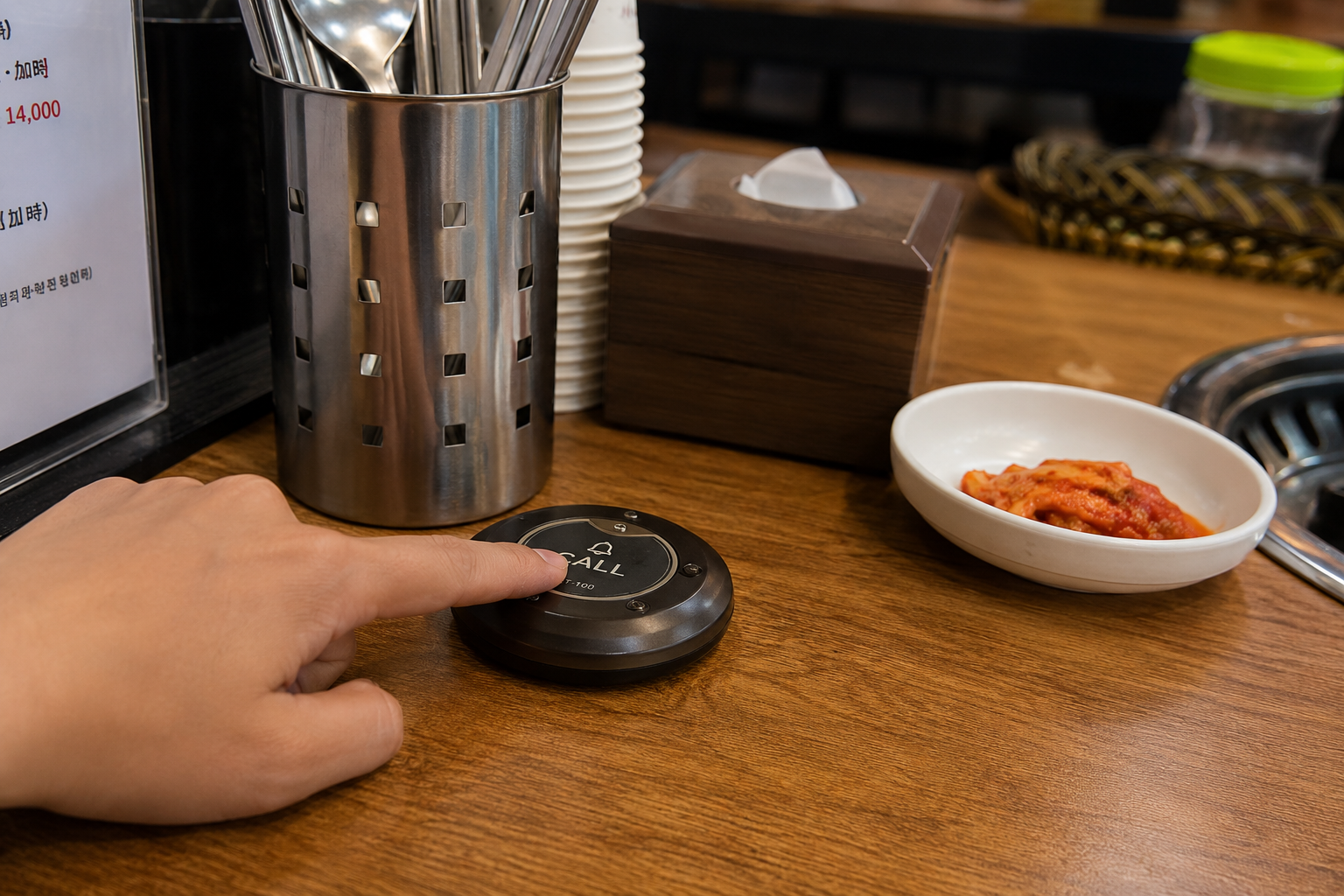
Imagine sitting at a restaurant and pressing a button whenever you need a waiter. No waving your hand. No trying to make eye contact. No awkwardly saying, “Excuse me.” Just one simple click.
In Korea, this is completely normal. One of the small cultural details that surprises many foreign visitors is the call button found on restaurant tables throughout the country.
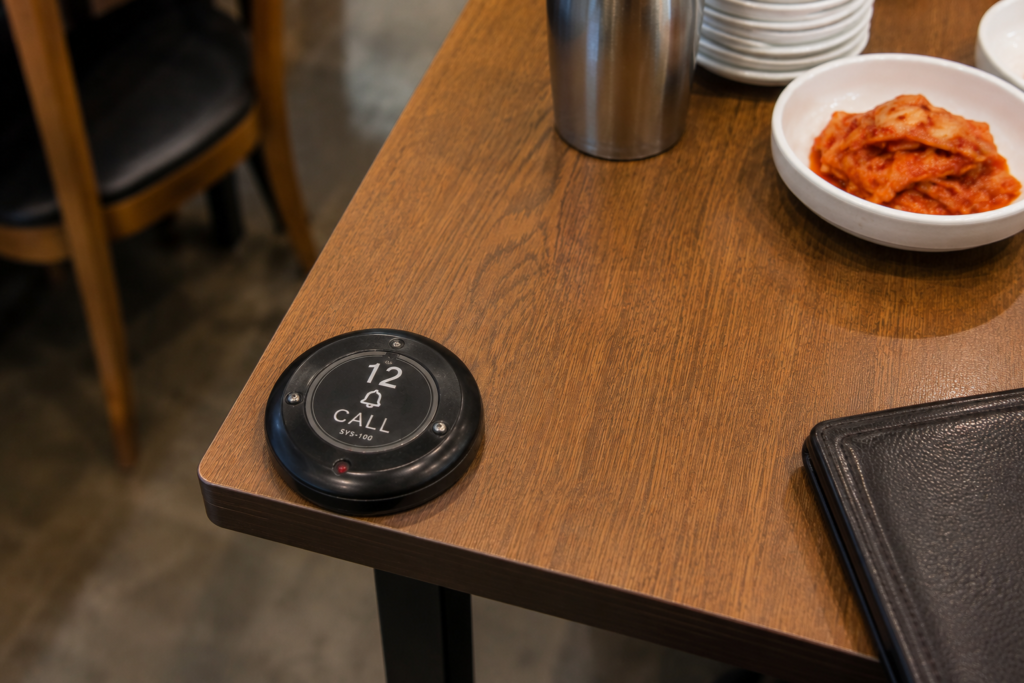
In many Korean restaurants, a small button is placed directly on the table. Customers use it whenever they want to place an order, request more side dishes, ask for drinks, or get assistance from the staff.
When you sit down at a restaurant in Korea, there is a good chance that a staff member will tell you: “Please call us when you’re ready to order.”
For Koreans, this sounds perfectly ordinary. What they actually mean is simple: “When you’re ready, press the button.”
Once you do, a receiver somewhere inside the restaurant makes a sound. Depending on the restaurant, it may be a ding-dong, a short chime, or another alert sound. At the same time, a display screen shows the number of the table that requested service. The staff checks the number and quickly walks over to help.
There is also one funny situation that happens quite often. Imagine going to a restaurant with a group of friends. Everyone is still looking at the menu and trying to decide what to order.
Then suddenly, that one impatient friend presses the call button before anyone has actually made a decision. A few seconds later, the staff member arrives and asks, “Are you ready to order?”
The problem is that nobody is ready. I have experienced this more than once.
Instead of awkwardly asking the staff member to come back later, we usually turn the situation into an opportunity. “We are thinking about ordering these dishes. Is there anything you would recommend?”
Surprisingly, this often helps. Restaurant staff usually know which dishes are most popular, and their suggestions can make the decision easier.
For many foreigners, however, the real challenge is not pressing the button. It is finding it.
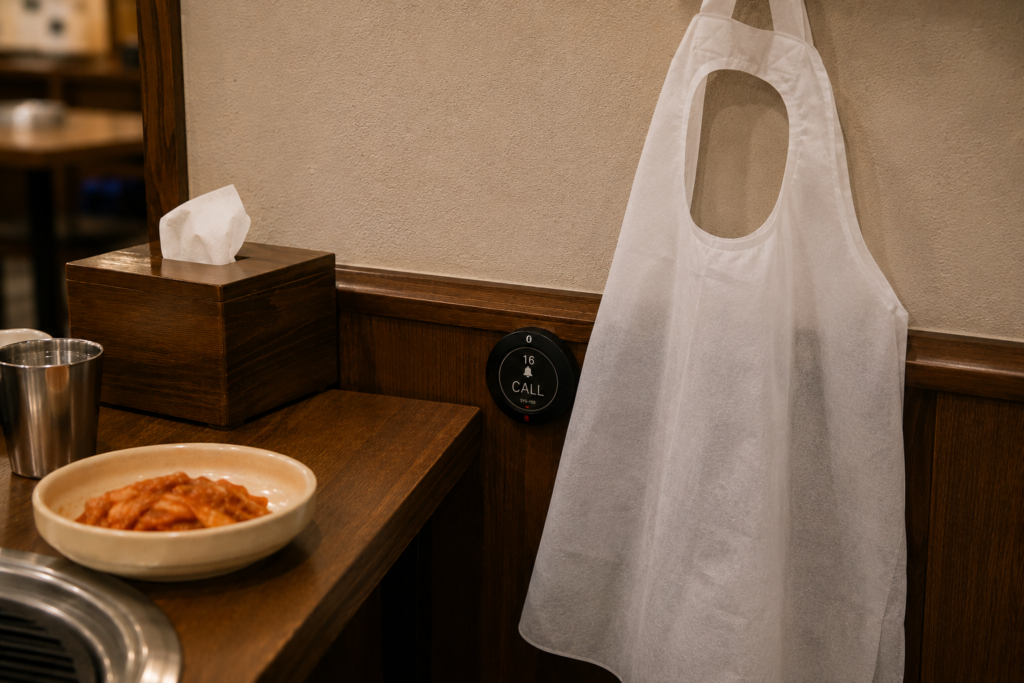
Sometimes the call button sits in the middle of the table where everyone can easily see it. Other times, it seems to play a small game of hide-and-seek.
I have seen call buttons attached to the side of tables, mounted on nearby walls, hidden next to utensil drawers, or attached to tissue boxes and utensil holders.
For Koreans, this is completely normal. For first-time visitors, it can sometimes take a few minutes to figure out where the button is hiding.
For most Koreans, this entire system is so common that we rarely think about it. For many foreigners, however, it can feel surprisingly unusual.
In many countries, customers are expected to wait for a waiter to come by, make eye contact, raise a hand, or politely say, “Excuse me.” The process is often slower and more relaxed.
Korea tends to work differently. Many Koreans value efficiency and quick service, and the restaurant call button reflects that mindset perfectly.
I remember experiencing this cultural difference myself while staying in Europe. When I first visited restaurants there, I sometimes found myself wondering why service seemed so slow. The staff did not come over immediately, and I often had to wait until they noticed me.
At first, it felt frustrating. Later, I realized it was not a matter of good or bad service. It was simply a different culture.
In many European countries, restaurants are designed to encourage customers to enjoy their meals at a slower pace. People spend time talking, relaxing, and enjoying the atmosphere.
In Korea, customers generally expect faster service whenever they need something. The restaurant call button is one small example of how that cultural preference has shaped everyday life.
Of course, pressing the button does not guarantee that someone will appear instantly. Restaurants can get extremely busy, especially during lunch and dinner rush hours. Sometimes I press the button and notice that another table’s number appears immediately afterward. Occasionally, staff members are simply too busy to respond right away.
When that happens, most Koreans do not panic. They usually wait a little while and then press the button again. Honestly, I do the same thing. If nobody comes after a reasonable amount of time, I might press it two or three times.
And if the restaurant is especially busy, many people simply stop waiting and solve the problem themselves. Some people get their own water. Others grab extra napkins, utensils, or plates without asking for assistance.
Part of this comes from Korea’s famous “ppalli-ppalli” culture, which roughly translates to “hurry, hurry.” Koreans are so used to getting things done quickly that waiting without doing anything can sometimes feel strange.
I noticed this even more when I traveled abroad. At some restaurants, I found myself wondering why nobody had come to take my order yet. Looking back, I realized the service was not slow at all. I was simply used to a different system.
The call button fits naturally into that mindset. It allows customers to ask for help exactly when they need it, while helping restaurants serve many tables efficiently at the same time. At the same time, many Koreans understand when staff members are overwhelmed, which is why it is common to see people helping themselves whenever possible.
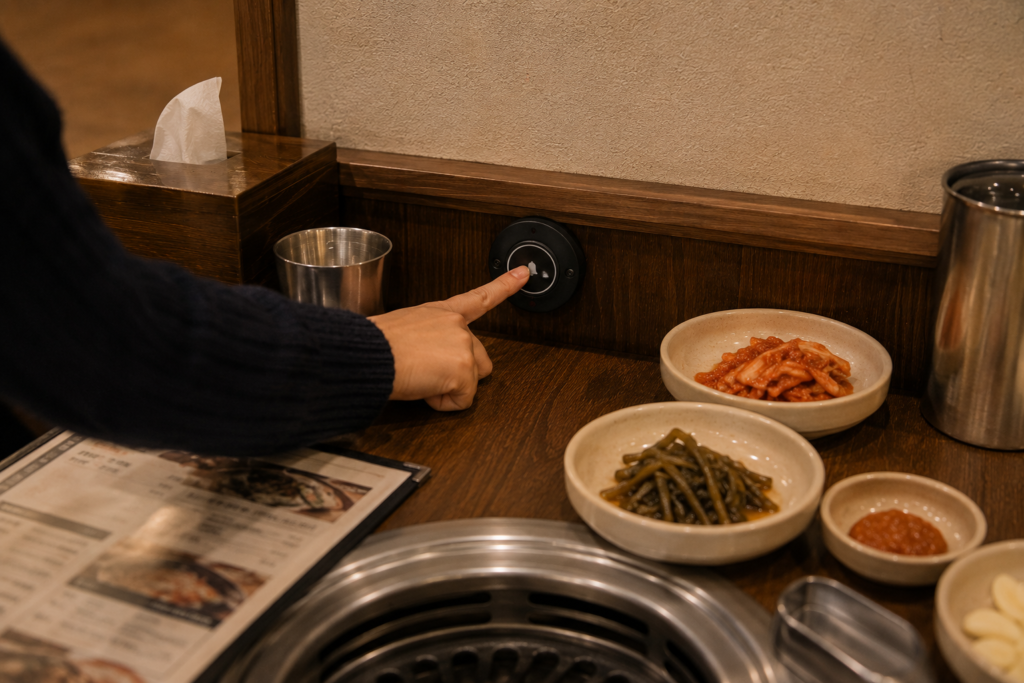
Personally, I think the greatest benefit of the call button is that it helps shy people. Before call buttons became common, customers often had to raise their voices to get a staff member’s attention. In crowded and noisy restaurants, that could feel uncomfortable, especially for introverted people.
Now, all it takes is a single press of a button. The staff can easily see which table needs help, and customers can ask for what they need without feeling awkward. It is a simple system, but it works remarkably well.
So if you ever visit Korea and notice a small button sitting somewhere around your table, don’t be afraid to use it. You may have to find it first. But once you do, you will be using a system that millions of Koreans rely on every day.
For locals, it is one of the most ordinary things in the world. For many visitors, however, it might become one of the most memorable parts of the Korean dining experience. And who knows? That little button may end up helping you choose your dinner, too.
Now I’m curious. How do you usually get a waiter’s attention in your country?
Leave a Reply